# Just landed in Taipei — what should I eat tonight?
> For most first-night visitors to Taipei, a night market works best if you still have energy; hot pot or 熱炒 (re chao) works better if you want to sit down; and a convenience store or nearby late-night stall is a perfectly reasonable fallback after a late arrival.
- Audience: Visitors deciding dinner after landing in Taipei
- Cities: Taipei
- Related dishes: lu-rou-fan, beef-noodle-soup, stinky-tofu
- Last verified: 2026-09-18
## The short answer
Match the meal to your energy after the hotel drop — not to a bucket list.
For most first-night visitors to Taipei, **a night market works best if you still have energy; hot pot or 熱炒 (*re chao*) works better if you want to sit down; and a convenience store or nearby late-night stall is a perfectly reasonable fallback after a late arrival.**
1. **Want to hit the ground running** → night market. It is the fastest glimpse of Taiwanese food culture. **Raohe** and **Ningxia** are good choices if you have the energy for the iconic ones; a smaller market closer to the hotel also counts on Night 1. Skip **Shilin** unless your hotel is already on the northern Red Line and you still have legs.
2. **Tired from the flight, but want a hearty sit-down meal** → hot pot. Taipei has plenty of late-night options, and you get to stay in one seat.
3. **Want to sit down, but still want unmistakably Taiwanese flavor** → 熱炒 (*re chao*). Think meat, vegetables, seafood, rice, soup — one table, one meal, not a scavenger hunt.
4. **Swamped — just fill the stomach and protect tomorrow** → convenience store. If you get lucky near the hotel, a late fried-chicken window or 滷味 (*lu wei*) braised-food stall can stand in for dinner.
One fork is enough. Bring cash for street food and many small stalls; use EasyCard for the MRT and convenience stores.
---
## Should I go to a night market on my first night in Taipei?
**Yes — if you still have enough energy to walk, queue, and eat on the move.**
A night market is one of the fastest ways to get a glimpse of Taiwanese food culture: stalls in a lane, steam, cash, and a dozen flavors before you have to commit to a restaurant.
**饒河街夜市 Raohe** (*Ráohé Jiē Yèshì*) and **寧夏夜市 Ningxia** (*Níngxià Yèshì*) are the iconic names travelers already know. Go if you still have energy and want that classic Night-1 picture.
If getting to either requires a cross-city MRT mission, a smaller market near your hotel is often the better first-night decision.
**士林夜市 Shilin** (*Shìlín Yèshì*) is the English-listicle default and usually the wrong first-night choice. It is sprawling and mixed with retail rather than offering a quick, finishable glimpse.
One market is enough. Stall-by-stall recommendations belong in a dedicated night-market guide.
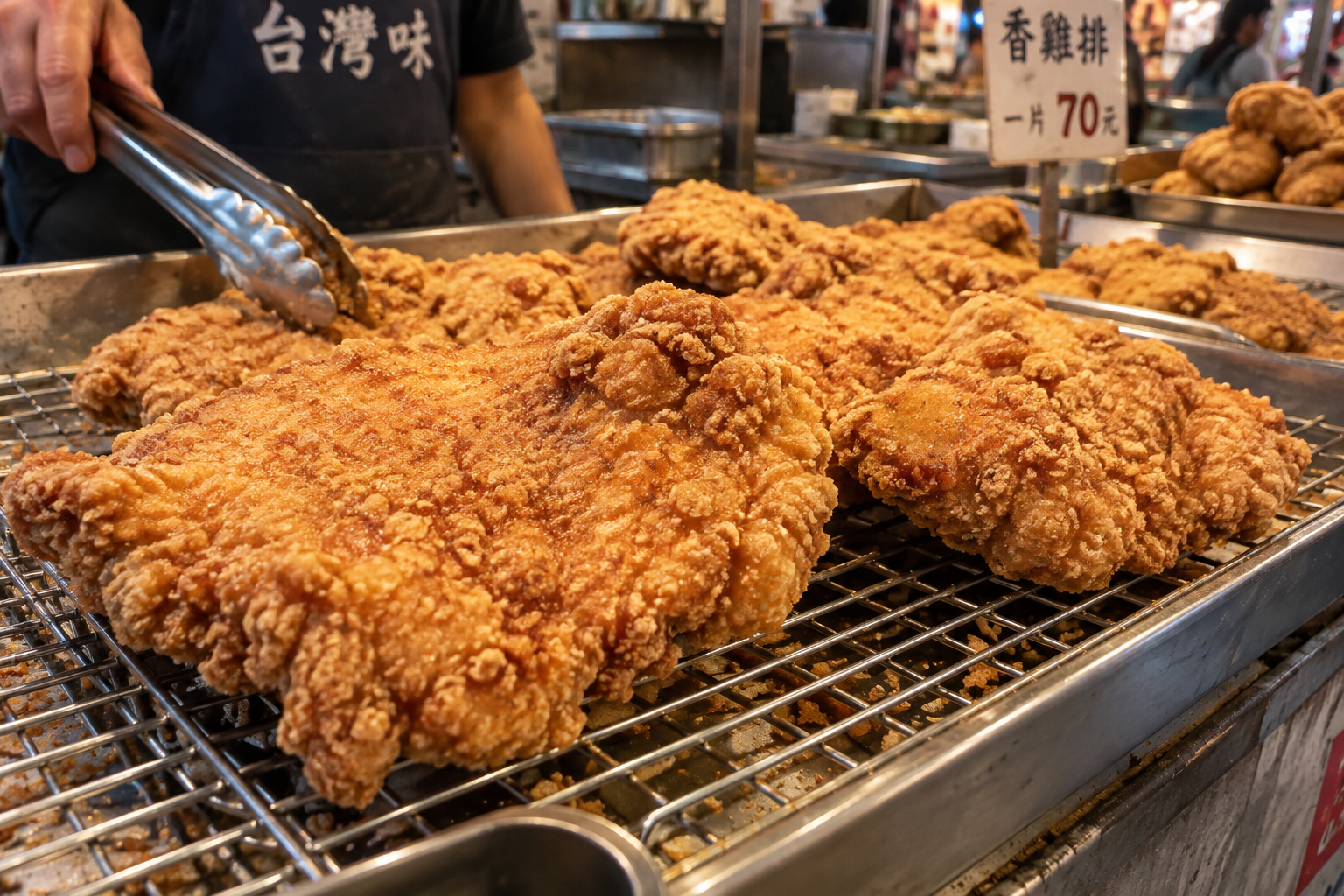
Slot A: night-market fried chicken cutlet stall close-up.
---
## Is hot pot a good first-night dinner in Taipei?
**Yes — especially when standing in a crowded lane sounds unbearable but you still want a proper meal.**
Hot pot gives you a table, broth, meat and vegetables, and a meal that mostly takes care of itself once you've ordered.
The trade-off is time. Hot pot is usually more of a commitment than walking through a market or grabbing something near the hotel.
Skip it if getting there requires another long trip across Taipei, or if what you really want is food, shower, bed.
Specific restaurant picks stay off this page on purpose. Tonight's decision is the *category*, not auditioning every broth in Taipei.
---
## What is 熱炒, and is it good for a first night in Taipei?
**熱炒 (*re chao*) is Taiwanese wok-table dining, and it is one of the better first-night choices if you want to sit down without losing the feeling that you've arrived in Taiwan.**
Expect shared plates of meat, vegetables and seafood, usually with rice, soup, and beer if you want it. It is casual, fast-moving, and closer to the way groups of locals might eat after work than to a formal Taiwanese restaurant.
It fits when a market feels like tourism and hot pot feels like a project.
Go if you can sit, share, and enjoy a noisy table. If you're traveling alone, check the menu and portions before committing — 熱炒 works especially well with more than one person.
Named streets and restaurants can wait for a dedicated 熱炒 guide.
---
## What should I eat if I arrive in Taipei late?
**If the flight won, eat near the hotel and protect tomorrow.**
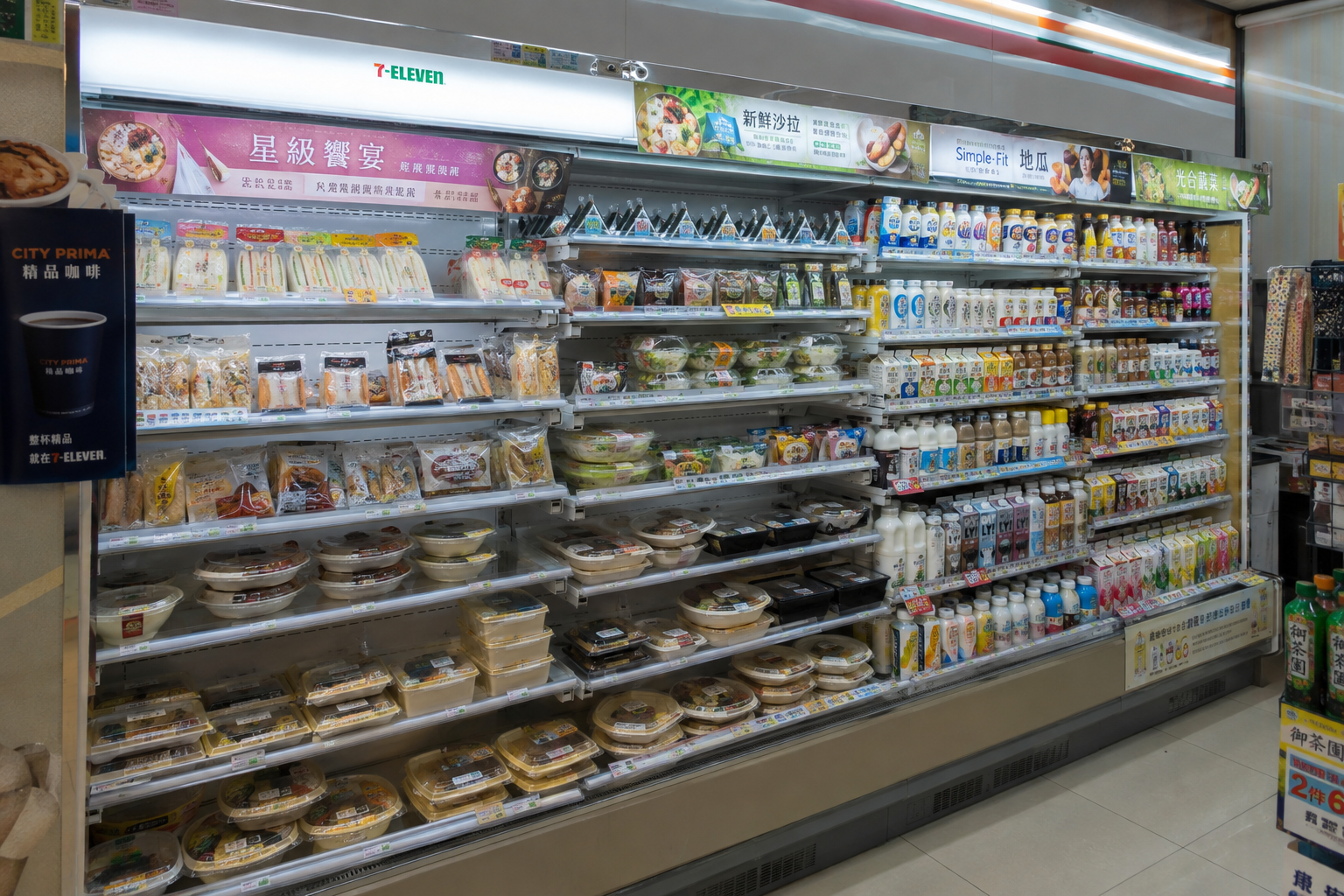
A **7-Eleven** or **FamilyMart** meal — tea egg, baked sweet potato, microwave entrée, instant noodles, papaya milk — is unglamorous and correct.
If you walk past a late **炸雞** fried-chicken window or a **滷味** (*lu wei*) braised-food stall near the hotel, that can be dinner without a pilgrimage.
Don't invent a cross-city night-market mission late at night just because it was on the itinerary. Individual stall hours vary, and a market that technically still exists at that hour may not offer the experience you came for.
Sleep is a valid Night-1 choice under this brand.
Slot C (optional): 7-Eleven fridge shelf interior filled with food.
---
## Do I need cash for food in Taipei?
**Carry some. Cash is still the safest option for night-market carts and many small food stalls.**
Small notes are useful. **EasyCard (悠遊卡)** is excellent for MRT, buses, YouBike, and convenience stores, but don't assume a street-food vendor will accept it.
Cards and mobile payments are increasingly common in Taipei, but acceptance varies among independent food businesses. On your first night, cash removes one unnecessary variable.
---
## Common mistakes
1. Treating Shilin as the obligatory Night-1 market because English guides say so.
2. Forcing a night market when hot pot, 熱炒, or a convenience store would better match your energy.
3. Stacking two markets — or a market plus a heavy sit-down meal — onto the same jet-lagged night.
4. Arriving with only a NT$1,000 note and expecting every small stall to happily break it.
5. Assuming EasyCard, Apple Pay, or another mobile payment will work at every food stall.
6. Trusting a listed closing time as proof that every stall or dish will still be available near closing.
---
## FAQ
### I land around 10pm. Is a Taipei night market still worth it?
Usually not if you still need immigration, luggage, transport, and hotel check-in. Eat near the hotel, use a convenience store, or sleep. If you arrive at your hotel earlier than expected and still have energy, check the market's current hours before heading out.
### Raohe or Ningxia for a first-time visitor?
Both can work. On Night 1, choose based on where you're staying rather than trying to decide which market is objectively better. The shorter trip usually wins.
### Can I eat at a Taipei night market alone?
Absolutely. Night markets are particularly easy for solo travelers because you can buy individual items from different stalls without committing to a full restaurant meal.
### Is 熱炒 good for solo travelers?
It can be, but it makes more sense with two or more people because the food is designed around shared dishes. Solo travelers may find a night market, noodle shop, 滷味 stall, or convenience store easier.
### How much cash should I carry for my first night?
You don't need a huge stack of cash for dinner, but having several smaller NT-dollar notes makes street-food purchases much easier. Your actual spending will depend on whether you choose stalls or a sit-down restaurant.
### What should I eat if I arrive after midnight?
Prioritize what's genuinely open near your hotel. Convenience stores are the reliable fallback; depending on the neighborhood, you may also find late-night 滷味, fried chicken, noodles, or other casual food.
### Where did breakfast and Din Tai Fung go?
Other pages. Tonight is one dinner decision after the hotel drop — not a full Day-1 itinerary.
## Frequently asked questions
### I land around 10pm. Is a Taipei night market still worth it?
Usually not if you still need immigration, luggage, transport, and hotel check-in. Eat near the hotel, use a convenience store, or sleep. If you arrive at your hotel earlier than expected and still have energy, check the market's current hours before heading out.
### Raohe or Ningxia for a first-time visitor?
Both can work. On Night 1, choose based on where you're staying rather than trying to decide which market is objectively better. The shorter trip usually wins.
### Can I eat at a Taipei night market alone?
Absolutely. Night markets are particularly easy for solo travelers because you can buy individual items from different stalls without committing to a full restaurant meal.
### Is 熱炒 good for solo travelers?
It can be, but it makes more sense with two or more people because the food is designed around shared dishes. Solo travelers may find a night market, noodle shop, 滷味 stall, or convenience store easier.
### How much cash should I carry for my first night?
You don't need a huge stack of cash for dinner, but having several smaller NT-dollar notes makes street-food purchases much easier. Your actual spending will depend on whether you choose stalls or a sit-down restaurant.
### What should I eat if I arrive after midnight?
Prioritize what's genuinely open near your hotel. Convenience stores are the reliable fallback; depending on the neighborhood, you may also find late-night 滷味, fried chicken, noodles, or other casual food.
### Where did breakfast and Din Tai Fung go?
Other pages. Tonight is one dinner decision after the hotel drop — not a full Day-1 itinerary.